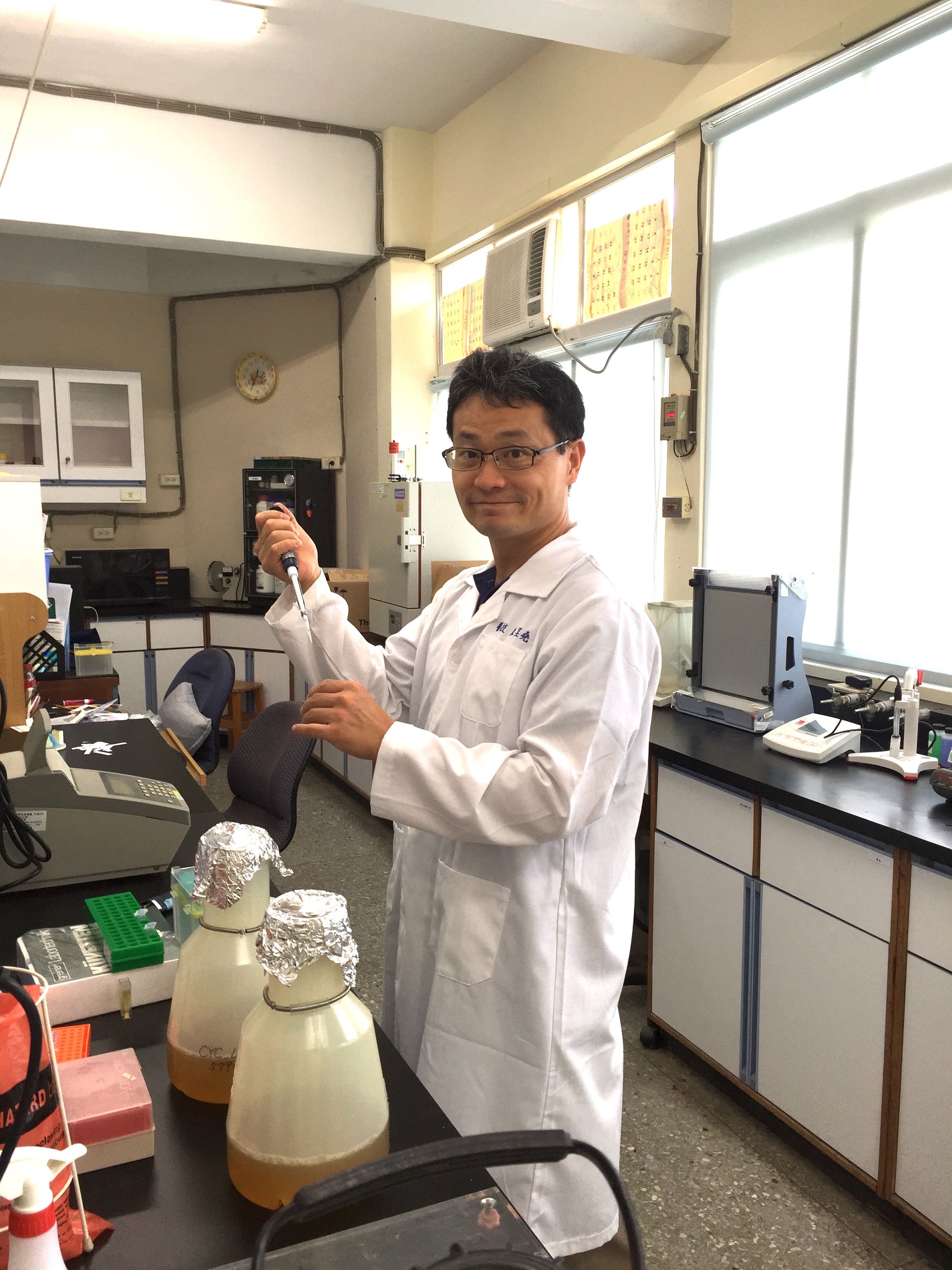
| Name: | Cheng-Yao Chen |
|---|---|
| Lab place: | Room 5790, 4F Department of Medical Laboratory Science and Biotechnology |
| E-mail: | chengyao@mail.ncku.edu.tw |
Education
- Ph.D., Molecular & Cellular Biology, Oregon State University, Corvallis, Oregon, U.S.A.
- M. S., Clinical laboratory Science, State University of New York at Buffalo, Buffalo, New York, U.S.A.
- B. S., Medical Technology, Taipei Medical University, Taipei, Taiwan, R.O.C.
Research
My long-term research interests involve understanding the molecular basis of mutagenesis, including the specific functions of mutations in molecular evolution and tumorigenesis. My studies will address three fundamental questions:
- How do normal cells faithfully replicate their genomic DNA?
- How do cells accurately repair damaged DNA and maintain genetic integrity?
- How does accumulation of mutations drive molecular evolution and cellular transformation?
My future research will focus on these topics:
I) Fidelity of DNA replication
The basic function of DNA polymerases are to faithfully duplicate the entire genome, and in doing so, pass down the correct genetic information to future generations. DNA polymerases can replicate DNA with phenomenally high accuracy, approaching 1 error in every 10 million nucleotides incorporated [1]. Factors that govern and influence the fidelity of DNA replication have been widely studied [2, 3]. However, the relationship between replication fidelity and spontaneous mutation rate/frequency remains unclear. My future research will aim to determine the accuracy of DNA synthesis via mammalian DNA polymerases, both in vitro and in vivo, in order to elucidate this relationship.
II) Accuracy of DNA damage repair
The integrity and intrinsic stability of cellular DNA is constantly challenged via normal metabolic pathways, environmental factors, i.e., UV/irradiation, chemotherapeutic drugs, and chemical carcinogens [4, 5, 6]. If DNA lesions are left unrepaired, they will disrupt Watson-Crick base pairing geometry during DNA replication [7] and introduce mutations within the cellular genome [8]; potentially affecting the function and viability of cells. Hence, living cells from eukaryotes, bacteria, and archaea have evolved various repair mechanisms [4], including base-excision repair (BER), mismatch repair (MMR), nucleotide-excision repair (NER), and double-strand break repair (DSBR). These repair pathways function to sense and repair different types of damaged lesions that occur to DNA. In humans, defects in DNA repair mechanisms predispose afflicted individuals to various genetic diseases and cancers. These disorders include ataxia-telangiectasia (AT) [4, 9], a degenerative motor disease caused by a failure to repair oxidative DNA damage in the cerebellum; xeroderma pigmentosum (XP) [4], an autosomal recessive genetic disorder linked to an inability to repair damaged DNA caused by UV/irradiation in epidermal cells; hereditary non-polyposis colon cancer (HNPCC) [4, 10], an autosomal dominant genetic disorder associated with a defective DNA mismatch repair function within colorectal tissue. Although mechanisms of DNA repair pathways are well documented, the corresponding repair fidelities are less well studied. To illuminate this area of research, I will use biochemical and genetic tools in tandem to investigate DNA repair fidelity in vitro and in vivo.
III) Applied molecular evolution
Advances in molecular biology techniques and directed-enzyme evolution have made it feasible to create tailor-made enzymes with novel properties for emerging biomedical and industrial applications. In my future research, I plan to use a combination of protein-engineering tools and computational approaches for improving protein properties in clinical diagnostic applications. PCR enzymes, including thermostable DNA polymerases, or antibodies, funneled through molecular evolution processes will be purified and tested in existing, or novel, diagnostic assays. In a few years, I wish to build a robust protein engineering platform and collaborate closely with both foreign and domestic industrial partners [11-16].
References
- Chen, C.-Y. (2014) DNA polymerases drive DNA sequencing-by-synthesis technologies: both past and present. Front. Microbiol.5:305 (Invited Reviews)
- Kunkel TA. (2009) Evolving views of DNA replication (in)fidelity. Cold Spring Harb. Symp. Quant. Biol. 74:91-101
- Kennedy, S. R., Chen C.-Y., Schmitt, M. W., Bower, C. N., and Loeb, L. A. (2011) The biochemistry and fidelity of synthesis by the apicoplast genome replication DNA polymerase Pfprex from the malaria parasite Plasmodium falciparum. J. Mol. Biol. 410(1): 27-38
- Friedberg, E.C, Walker, G,C, Siede, W., Schultz, R.A. (2006). DNA repair and mutagenesis (2nd ed.). ASM Press
- Chen, C.-Y., Guo, H.H., Shah, D., Blank, A., Samson, L., Loeb, L. A. (2008) Substrate binding pocket residues of human alkyladenine-DNA glycosylase critical for methylating agent survival. DNA Repair (Amst) 7(10):1731-45
- Lari, S.U., Chen, C.-Y., Vertessy, B.G., and Bennett, S.E. (2006) Quantitative determination of uracil residues in Escherichia coli DNA: Contribution of ung, dug, and dut genes to uracil avoidance. DNA Repair (Amst) 5(12):1407-1420
- Bebenek K, Pedersen L.C., and Kunkel T.A. (2011) Replication infidelity via a mismatch with Watson-Crick geometry. Proc. Natl. Acad. Sci. U. S. A. 108(5):1862-7
- Friedberg E.C. Suffering in silence: the tolerance of DNA damage. (2005) Nat. Rev. Mol. Cell. Biol. 6(12):943-53
- Biton S, Barzilai A, Shiloh Y. (2008) The neurological phenotype of ataxia-telangiectasia: solving a persistent puzzle. DNA Repair (Amst). 7(7):1028-38.
- Papadopoulos N., et al. (1994) Mutation of a mutL homolog in hereditary colon cancer. Science. 263(5153):1625-9
- US8236975 - "Nucleotide Transient Binding for Sequencing Methods"
- US20100255487 - "Method and Apparatus for Single Molecule Sequencing Using Energy Transfer Detection"
- US20110014612 - "Polymerase Compositions and Methods"
- US20110312529 - "Conformational Probes and Methods for Sequencing Nucleic Acids"
- US20130165328 - "Apparatus and Methods for Kinetic Analysis & Determination of Nucleic Acid Sequences"
- US20140065675 - "Modified Polymerases for Improved Incorporation of Nucleotide Analogues"
- Chen, C.-Y., Mosbaugh, D.W., and Bennett, S.E. (2005) Mutations at Arg276 transform human uracil-DNA glycosylase into a single-stranded DNA-specific uracil-DNA glycosylase. DNA Repair (Amst) 4(7):793-805
- Chen, C.-Y., Mosbaugh, D.W., and Bennett, S.E. (2004) Mutational analysis of Arg276 in the leucine-loop of human uracil-DNA glycosylase. J. Biol. Chem. 276(46), 48177-8